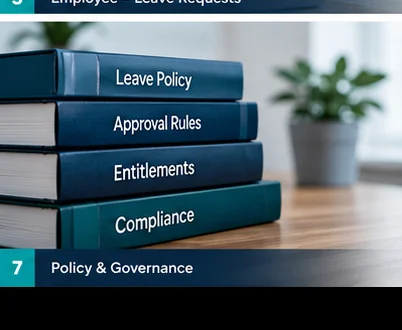
- What leave am I entitled to, and how is it calculated?
- How do I request it, and who determines the timing?
- When is supporting evidence required?
- What happens if several people want the same dates?
- What happens to unused leave?
A policy that cannot answer these questions is unlikely to create consistent practice.
1. Define who the policy covers
Identify whether the organisation has:
- permanent employees;
- fixed-term employees;
- part-time employees;
- shift workers;
- employees at different locations;
- employees subject to bargaining-council arrangements; or
- other categories requiring different treatment.
Do not assume everyone has the same working pattern.
2. Define every leave type
The policy should identify the leave recognised by the organisation.
This may include:
- annual leave;
- sick leave;
- family responsibility leave;
- parental leave;
- unpaid leave;
- study leave;
- compassionate or special leave; and
- additional contractual benefits.
Make clear which entitlements arise from legislation and which are additional company benefits.
3. State the actual entitlement
Simply stating that “annual leave is provided in accordance with the BCEA” does not tell employees what the company actually provides. Employees should know what the company actually provides. For example, a policy could state: “Employees working a conventional five-day week receive 20 working days of annual leave per annual-leave cycle.” If the employer provides more than the statutory minimum, the policy should distinguish the additional benefit where relevant.
4. Explain the cycle and calculation
Specify:
- when the leave cycle starts;
- how leave is accrued or allocated;
- how different working patterns are handled;
- how public holidays are treated;
- how adjustments are made; and
- what the displayed balance means.
5. Explain how employees request leave
Employees should know:
- Where do I submit the request?
- How much notice is normally expected?
- Who considers the timing?
- When do I know the dates are confirmed?
“Tell your manager” is not a complete leave process.
6. Define decision principles
Managers should have guidance on:
- overlapping requests;
- minimum staffing;
- critical skills;
- peak periods;
- shutdown periods;
- existing approved leave;
- pending requests; and
- alternative dates.
The purpose is consistent decision-making.
7. Deal with sick leave separately
Explain:
- the 36-month cycle;
- the first-six-month rule;
- notification procedures;
- supporting documentation;
- recordkeeping; and
- confidentiality.
Sick leave should not simply copy the annual-leave workflow.
8. Correct old family-responsibility wording
Qualifying employees generally receive three days’ paid family responsibility leave per annual cycle for circumstances still covered by section 27. Do not copy old templates that continue to classify the birth of a child as family responsibility leave. The 2018 Act enacted the repeal as part of the parental-leave framework; the relevant BCEA amendments commenced on 1 January 2020.
9. Update parental-leave wording
Policies written before the October 2025 Constitutional Court judgment require particular attention. The policy should recognise the current interim legal framework and be drafted so that it can be updated when remedial legislation comes into operation. Avoid hard-coding proposed 2026 amendments as though they are already law.
10. Address carry-over carefully
Avoid simplistic wording such as “all unused leave automatically expires.” Distinguish between statutory leave and additional contractual benefits and obtain appropriate advice where the organisation wants to introduce forfeiture rules.
11. Define corrections and cancellations
What happens when:
- approved leave is cancelled;
- dates change;
- HR discovers a historical error;
- a manager selected the wrong dates; or
- an employee’s work pattern changes?
The policy should define who can make adjustments. The system should preserve the history.
12. Protect personal information
Leave records can contain sensitive personal and medical information.
Define:
- who may access it;
- what supporting information is actually required;
- how documents are stored;
- appropriate retention;
- security controls; and
- who may see medical information.
13. Keep an audit trail
For important transactions, the organisation should be able to reconstruct:
- The request submitted.
- The decision made.
- Any subsequent adjustment.
- The resulting balance impact.
Reliable records allow the organisation to explain its decisions without adding unnecessary bureaucracy.
14. Version the policy
Every policy should contain:
- Policy owner
- Version
- Approval date
- Effective date
- Last legal review
- Next review date
This is especially important while parental-leave law is evolving.
From policy to practice
A PDF policy alone is not a complete control.
The stronger model is:
- The policy defines the rule.
- The system applies the rule.
- The employee sees the result.
- The manager sees the operational context.
- The audit history records what happened.
That is where LeaveCtrl fits.
Primary sources & scope
These guides prioritise official legislation, court decisions and government guidance. Read the applicable Act with amendments and later court decisions.
BCEA 75 of 1997 — Act and amendments, South African GovernmentLabour Laws Amendment Act 10 of 2018 and commencement datesVan Wyk full judgment and operative order — Parliament-hosted copy (PDF)Van Wyk [2025] ZACC 20 — Constitutional Court case and nonbinding summaryEditorial method: Statutory rules, court decisions, proposals and operational good practice are treated separately. Read our approach.
General information, not legal advice. Individual facts, employment terms, collective agreements and later developments can change the position. For a material or disputed case, obtain appropriate professional advice.From an answer to a clearer process.
Configure your organisation’s leave rules in LeaveCtrl.