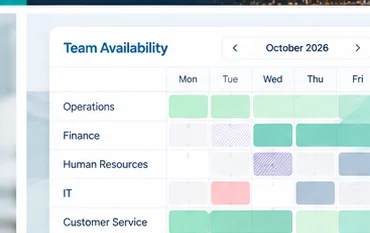
Leave planning is capacity planning
December planning needs two perspectives:
- Entitlement: does this employee have enough leave?
- Availability: what will the team look like if the request is accommodated?
Suppose eight employees perform an important function. Two are already approved for leave. Two more requests are pending. Another request arrives. Looking at the fifth employee’s balance in isolation tells the manager very little about the operational consequences.
Start early
Businesses with predictable year-end leave demand should communicate their process well in advance.
Employees should know:
- shutdown dates, if applicable;
- when preferred leave periods should be submitted;
- when decisions will be communicated;
- how competing requests will be considered;
- which critical functions require coverage; and
- how disputes or exceptional circumstances are escalated.
Early planning benefits employees as much as employers. Travel and family arrangements are easier when decisions are made in reasonable time.
Start with critical functions, not names
Identify the functions that must continue, then determine the minimum capability required to perform them.
- A customer-support operation may need coverage across several channels.
- A medical practice may need both clinical and administrative capacity.
- A field operation may need designated supervisory or safety capability.
- A finance team may need specific skills around month-end.
Saying “four people will be working” is not enough if none of those four can perform the critical function.
Show approved and pending leave
This distinction matters. A manager who sees only approved absence may unknowingly have several conflicting requests waiting elsewhere.
The workforce view should distinguish:
- Available
- Approved away
- Pending leave
- Other known absence
Pending leave should not be represented as approved—but managers need to know it exists.
Use staffing thresholds as warnings
Suppose a ten-person team requires at least six people available for normal operations. A request would reduce projected availability to five. LeaveCtrl could display a coverage warning explaining that approving the dates may reduce the team below its configured staffing threshold. That should ordinarily inform the decision rather than automatically reject the request. Managers still need judgment.
Apply transparent criteria
Where demand exceeds available capacity, organisations may consider criteria such as:
- timing of requests;
- previous peak-period allocations;
- rotation;
- operational requirements;
- critical skills;
- existing approved leave; and
- exceptional circumstances.
The appropriate model will differ between organisations. The important principle is that employees should understand how decisions are made.
Avoid risky blanket rules
Employers should be cautious about:
- automatically prohibiting all December leave;
- refusing requests indefinitely;
- applying different rules to favoured employees;
- ignoring statutory entitlements;
- forcing unpaid leave without an appropriate basis;
- incorrectly deducting public holidays; or
- waiting until December to identify a staffing problem.
Plan January too
The problem does not end on 31 December. Employees return on different dates. Suppliers reopen. Schools restart. Customers return. Operational demand may recover before the workforce does. A good availability planner therefore shows the full December–January period.
What should a manager see?
Consider Customer Support in the week of 14 December:
- Total employees: 8.
- Currently working: 5.
- Approved away: 2.
- Other known absence: 1.
- Pending requests among currently available employees: 1.
- Current availability: 62.5%.
- Availability if the pending request is accommodated: 50%.
- Configured minimum: 60%.
This scenario should trigger a coverage warning. That tells the manager far more than eight individual leave forms. Pending requests are an overlay on current availability, not another employee bucket. In this illustration, the one other known absence explains why five of eight employees are currently available.
Leave balance versus workforce availability
This distinction is central to LeaveCtrl.
Growing organisations need answers to both questions:
- How many leave days does Ayanda have?
- What happens to Ayanda’s team if these dates are accommodated?
December readiness checklist
Before the peak period, confirm that:
- shutdown dates are communicated;
- critical functions are identified;
- minimum coverage is understood;
- outstanding requests are visible;
- employees understand the process;
- managers can see overlapping requests;
- public holidays are correctly configured;
- January is included in the planning horizon; and
- unresolved conflicts are addressed early.
The objective is to enable legitimate leave while keeping the organisation operational. That is why LeaveCtrl brings leave management and workforce availability together.
Primary sources & scope
These guides prioritise official legislation, court decisions and government guidance. Read the applicable Act with amendments and later court decisions.
BCEA 75 of 1997 — Act and amendments, South African GovernmentEditorial method: Statutory rules, court decisions, proposals and operational good practice are treated separately. Read our approach.
General information, not legal advice. Individual facts, employment terms, collective agreements and later developments can change the position. For a material or disputed case, obtain appropriate professional advice.From an answer to a clearer process.
See approved leave, pending requests and projected availability in LeaveCtrl.